
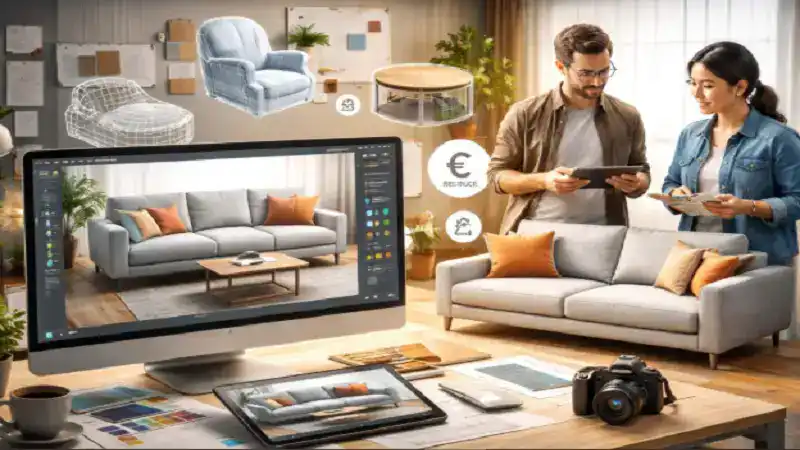
How Photorealistic 3D Furniture Helps Brands Reduce Prototyping Costs
Launching a new furniture collection has never been more competitive or more expensive.
From bespoke interiors in London to large-scale retail rollouts across the United States, furniture brands face mounting pressure to innovate quickly while keeping development costs under control. Traditional prototyping methods building multiple physical samples before final approval can drain budgets and delay launches.
This is where Photorealistic 3D Furniture visualization is transforming the industry.
By combining precision modeling with ultra-realistic rendering, furniture brands can now validate designs, impress stakeholders, and finalize collections all before producing a single physical prototype.
Let’s explore how this digital shift is reducing prototyping costs and reshaping the future of furniture design.
Why Is Traditional Furniture Prototyping So Expensive?
Physical prototyping involves more than just creating a sample.
It requires:
- Material sourcing
- CNC machining or handcrafting
- Finishing and polishing
- Shipping to showrooms
- Revisions and rebuilds
If a client or internal stakeholder requests changes to dimensions, finishes, color, structure the process often starts again.
For UK manufacturers managing rising material costs and supply chain uncertainty, this can significantly impact margins.
Digital-first brands are asking: Can we validate design decisions before building anything?
The answer is yes through Photorealistic 3D Furniture solutions.
What Is Photorealistic 3D Furniture?
Photorealistic 3D Furniture refers to highly detailed digital models and renders that replicate real-world materials, lighting, textures, and finishes with near-photographic accuracy.
Unlike basic 3D sketches, these visualizations simulate:
- Wood grain and material texture
- Fabric softness and folds
- Reflection and gloss levels
- Environmental lighting conditions
- True-to-scale proportions
Using advanced 3D Furniture Design Drawing workflows and rendering engines, designers can showcase products in lifelike interior settings without physical production.
How Does Photorealistic 3D Furniture Reduce Prototyping Costs?
The cost-saving advantages are significant.
1. Eliminates Multiple Physical Samples
Instead of building three or four prototype versions, brands can adjust dimensions or finishes digitally.
2. Faster Design Revisions
Changes to color, materials, or structure can be applied within hours using AutoCAD 3D Furniture Design workflows.
3. Early Stakeholder Approval
Photorealistic renders help investors, buyers, and retail partners visualize final products without ambiguity.
4. Reduced Shipping & Storage Costs
Digital previews eliminate the need to transport large sample furniture pieces.
5. Improved Manufacturing Accuracy
When paired with professional 3D Furniture CAD Design services, digital models can directly inform production specifications.
This dramatically lowers the risk of costly manufacturing errors.
Why Are UK Furniture Brands Accelerating Digital Adoption?
The UK furniture sector is evolving rapidly due to:
- Rising material costs
- Sustainability regulations
- Increased demand for custom interiors
- Growth in e-commerce
Online retail in particular has increased reliance on visualization. Customers buying furniture online need confidence in how products will look in their spaces.
According to the British Furniture Confederation, digital transformation is becoming critical for maintaining competitiveness in the UK market.
Brands using Furniture 3D Design Services are gaining a strategic advantage by reducing development cycles and improving buyer engagement.
Can Photorealistic Rendering Replace Physical Prototypes Completely?
Not always but it significantly reduces the number required.
High-end or technically complex pieces may still require at least one physical validation. However, by using accurate 3D Furniture Design Drawing models first, brands can ensure that only final, approved versions move to physical production.
This reduces:
- Trial-and-error sampling
- Material waste
- Labor inefficiencies
- Delayed product launches
The digital model becomes the foundation for precise manufacturing.
How Does AutoCAD 3D Furniture Design Improve Accuracy?
Precision matters in furniture manufacturing.
A few millimeters can affect assembly, structural stability, or packaging dimensions.
Using AutoCAD 3D Furniture Design, designers can:
- Create parametric models
- Test joinery and connections
- Validate ergonomic dimensions
- Generate accurate production drawings
These technical capabilities ensure that photorealistic renders are not just visually impressive but structurally accurate.
When supported by professional 3D Furniture CAD Design services, design intent aligns seamlessly with manufacturing reality.
How Does Digital Visualization Improve Client Confidence?
Client approvals are often a bottleneck in custom or commercial furniture projects.
Interior designers and architects want to see how a piece interacts with lighting, color schemes, and surrounding architecture.
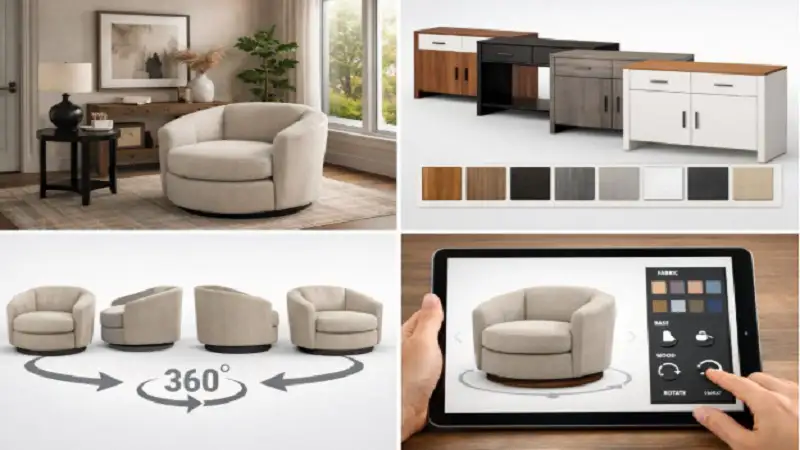
Photorealistic 3D Furniture enables:
- Realistic room simulations
- Custom finish previews
- 360-degree product views
- Interactive presentation models
This clarity reduces misunderstandings and prevents costly post-production changes.
For global brands serving international markets, digital previews simplify cross-border approvals.
Is Sustainability Driving the Shift to Digital Prototyping?
Absolutely.
Sustainability is becoming central to furniture manufacturing, especially in the UK and European markets.
Physical prototyping generates material waste, transportation emissions, and unused samples.
Digital modeling reduces environmental impact by:
- Minimizing discarded materials
- Reducing carbon-heavy shipping
- Optimizing material usage
- Supporting modular design
Brands integrating Furniture 3D Design Services are aligning with sustainability goals while improving efficiency.
How Are Startups and SMEs Benefiting?
Startups often lack the capital for extensive prototyping.
Partnering with a specialized 3D Furniture Design Company allows smaller brands to:
- Develop market-ready visual assets
- Validate product viability
- Create investor pitch visuals
- Launch online catalogs quickly
This lowers entry barriers in competitive markets like the UK and USA.
Digital modeling levels the playing field.
What Trends Will Shape Photorealistic 3D Furniture in 2026?
Several emerging technologies are accelerating adoption:
1. AI-Assisted Rendering
Faster generation of lifelike textures and materials.
2. Augmented Reality Integration
Allowing customers to preview furniture in their homes.
3. Parametric Customization
Dynamic resizing and modular adjustments.
4. Cloud Collaboration
Remote teams working simultaneously on design revisions.
5. Digital Twin Integration
Tracking production data alongside design models.
As these innovations expand, reliance on physical prototyping will continue to decline.
What Challenges Should Brands Consider?
Despite its advantages, digital transformation requires:
- Skilled CAD professionals
- High-quality rendering tools
- Structured data management
- Alignment between design and production teams
However, these challenges are manageable especially when working with experienced 3D Furniture CAD Design services providers.
The long-term cost savings typically justify the investment.
Final Thoughts
Furniture brands are under increasing pressure to innovate faster, reduce waste, and control costs.
Photorealistic 3D Furniture offers a practical solution by combining technical accuracy with lifelike visualization. When integrated with precise 3D Furniture Design Drawing workflows and advanced AutoCAD 3D Furniture Design, it becomes a powerful tool for reducing prototyping risks.
By minimizing physical sampling, accelerating approvals, and improving manufacturing precision, digital visualization is reshaping how furniture collections are developed.
Forward-thinking UK and global brands are already collaborating with experienced 3d cad design specialists to streamline workflows and maintain competitive advantage.
In an industry where margins are tight and customer expectations are rising, photorealistic 3D modeling is not just a visual upgrade, it’s a strategic cost-saving decision.
FAQs:
1. What is Photorealistic 3D Furniture?
Photorealistic 3D Furniture refers to highly detailed digital furniture models that replicate real-world materials, textures, lighting, and finishes to look nearly identical to physical products.
2. How does Photorealistic 3D Furniture reduce prototyping costs?
It minimizes the need for multiple physical samples by allowing brands to test designs, finishes, and dimensions digitally before manufacturing.
3. Is Photorealistic 3D Furniture accurate for production use?
Yes. When developed using professional 3D Furniture CAD Design services and precise 3D Furniture Design Drawing workflows, digital models can directly support manufacturing specifications.
4. How does AutoCAD 3D Furniture Design improve product accuracy?
AutoCAD 3D Furniture Design enables parametric modeling, dimension validation, and structural precision, reducing manufacturing errors and material waste.
5. Why are UK furniture brands adopting 3D Furniture Design Services?
UK brands face rising material costs and sustainability pressures. Furniture 3D Design Services help reduce waste, accelerate approvals, and improve online product presentation.
6. Can Photorealistic 3D Furniture replace physical prototypes completely?
In many cases, it significantly reduces the number of prototypes needed. However, final validation samples may still be produced for high-end or complex designs.
7. How does 3D Furniture Design Drawing help manufacturers?
3D Furniture Design Drawing provides detailed technical documentation, dimensions, joinery details, and assembly instructions for accurate production.
8. Is outsourcing to a 3D Furniture Design Company cost-effective?
Yes. Partnering with a specialized 3D Furniture Design Company allows brands to access expert modeling and rendering services without maintaining a large in-house design team.
9. Does Photorealistic 3D Furniture support sustainability goals?
Yes. Digital prototyping reduces material waste, lowers carbon emissions from shipping physical samples, and optimizes production planning.
10. What trends will shape Photorealistic 3D Furniture in 2026?
Emerging trends include AI-powered rendering, augmented reality product previews, cloud-based collaboration, parametric customization, and digital twin integration.
Learn more about interior design: RedandWhiteMagzcom